


Our thinking behind multi-device and sync
Designing for each device
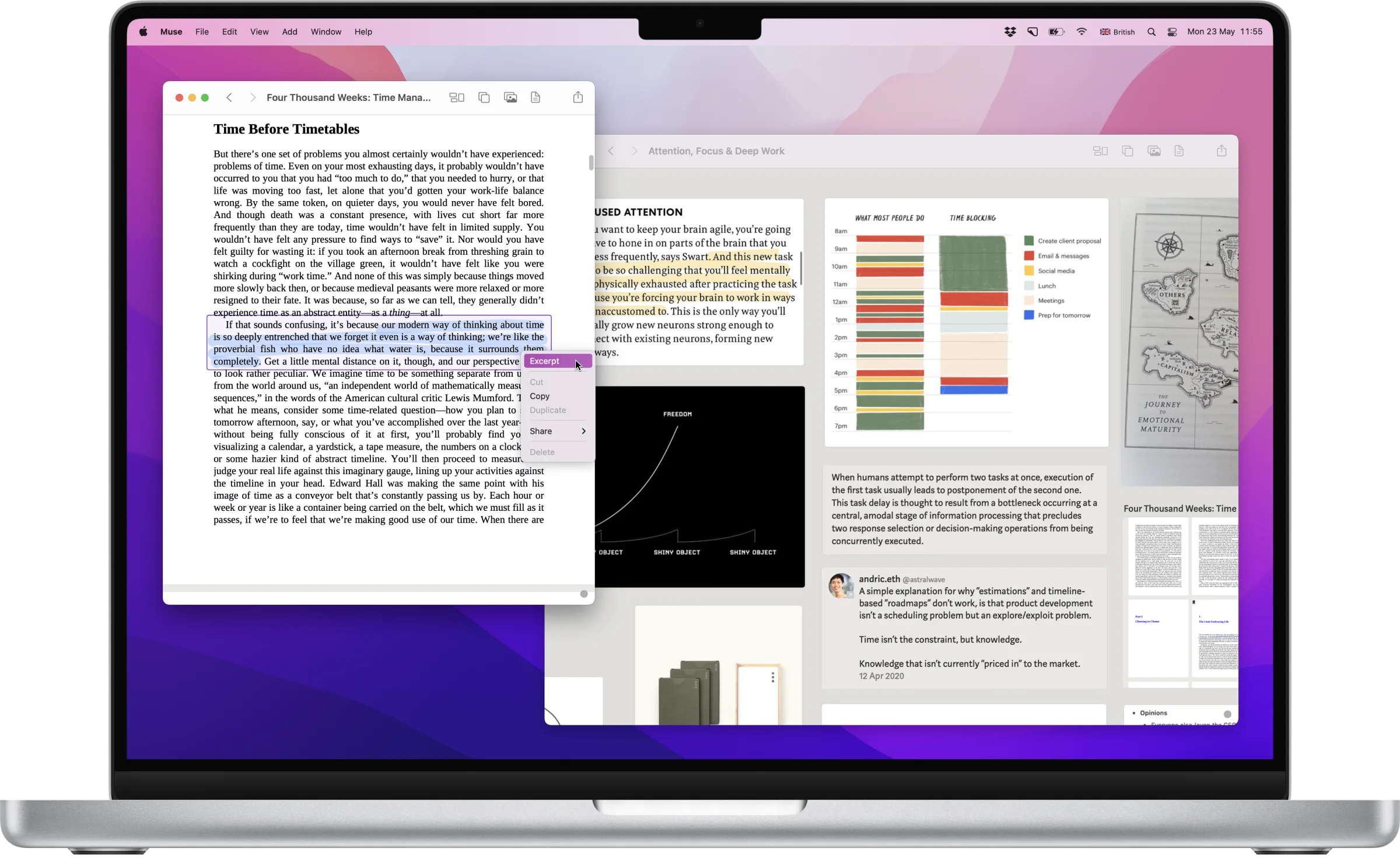
Creative professionals have a computing life that spans multiple devices, each with its own purpose. The phone is great for quick capture on the go, but isn’t a place to sit down and work out a complex spreadsheet. A workstation with a mouse and keyboard is great for heavy authoring tasks, but doesn’t offer good ergonomics for lengthy reading. And tablets are ideal for sitting back in your armchair to read and reflect.
| Platform | Purpose |
|---|---|
| Phone | quick capture and lookup |
| Tablet | annotating, sketching, brainstorming, sense-making |
| Desktop | heavy research, authoring, editing, bulk organizing |
| Web | sharing |
While many apps are available on multiple platforms, too often they were designed primarily for one device (say, a mobile phone) and offer only an awkward transliteration of their functionality to another place (say, the web on a desktop computer).
Here are some examples of the design choices we made for Muse on each platform.
iPad
- instantly respond to finger sliding across the glass
- sophisticated gestures like pull in new boards and throw out old ones
- fewer conventions here so we need to invent a bunch
- an interface with no toolbars to keep things distraction-free
Mac
- multi-select for bulk edits
- more screen real estate
- filesystem integration
Phone
- capture as quickly as possible so that you can record a note in the middle of conversation without being taken out of the moment
Why native apps
Muse for iPad and Mac are lovingly built as native apps. This means they run lighting fast and keep a copy of all your work locally. Though we love the web for many reasons, web technology cannot currently offer the fast, fluid, hardware-integrated experience that Muse wants to deliver to you.
Native also gives the benefit of greater system integration. Drag-and-drop, for example, is a crucial interaction for Muse where you’re often clipping content from other apps into a board, or taking finished boards and pulling out content into your authoring tool. Electron apps, for example, often struggle to offer reasonable drag-and-drop functionality.
And lastly it’s not just about technology: it’s about how the app feels, and whether it is a good citizen of the platform. On Mac, for example, there are many standards for menus, toolbars, window titles, and more. Wherever possible we strive to make sure Muse feels completely at home on the platform it’s running on.
Further reading
Local-first sync
It’s not enough to have Muse running on each of your devices; but also you need to access your work seamlessly across them. That implies sync.
A traditional cloud solution would be antithetical to our values of fast, intimate, and in your control. Hence we need sync that preserves the autonomy of your individual devices and gives you ownership of your data, while still connecting them together effortlessly.
Conveniently and not coincidentally, two of the Muse partners are coauthors of the essay Local-first software: You own your data, in spite of the cloud. This widely-cited academic paper summarizes a decade of work on a technology that has the promise to give users the benefits of the cloud (device syncing and multi-user collaboration) while also keeping data local for speed, offline capability, and greater agency over your work.
Further reading
A medium for thought
We want Muse to be not just an app for one platform, but a tool for thinking that is available everywhere that is a part of your thinking process. And to connect it all together such that you can switch between them seamlessly.
Given this vision, perhaps tool is not even the right term. As Andy Matuschak and Michael Nielsen (quoting Alan Kay) write:
What’s more, the term “tool” implies a certain narrowness. […] A medium creates a powerful immersive context, a context in which the user can have new kinds of thought, thoughts that were formerly impossible for them. Speaking loosely, the range of expressive thoughts possible in such a medium is an emergent property of the elementary objects and actions in that medium. If those are well chosen, the medium expands the possible range of human thought.
We believe that a Muse which spans all your devices has the potential to be this type of immersive context. And thereby to expand the breadth and depth of your creativity, your problem-solving ability, and your ideas.